Some cleanup happened during the last install at HJRO.
I've been hearing about plans to remove the large shelve unit in HJRO and make things more "streamlined" and professional inside.
From time to time people bring in and loan or donate items at HJRO. Sometimes these items are used, sometimes they are set aside and we use them on an as needed basis. This stuff can collect inside the small observatory and during the day, we can see the mess more. It's not as streamlined as it might be for a public observing place.
But there is another story to this as well. At night, most don't really look at the shelves at the observatory. They are looking at the telescope and objects. This is not meant to be an excuse to keeping a sloppy ship at the site, but most don't notice how cluttered or uncluttered the shelves are at night because the lights are off and it's dark.
It' a challenge to figure out what we should have inside or not have stored inside.
Ideally we'd have three astronomers or more show up with equipment and they will put their stuff they bring on an empty spot on the shelves and have their stuff over there off the floor. We might even have other features. One of the members mentioned hooks for coats to be hung on some time back.
It seems that the observatory at times is used by a few regulars and we bring a few items in. Sometimes they end up on the floor. Why? We keep more stuff, and things on the shelves, because we have more space. We tend to "fill up the space we have" and not clean house much.
There are seasonal things as well that end up inside, that may not be used much. Things like a large broom handle that is used to brush off snow off the dome. A couple of heaters inside which are handy when it's cold out. People love those heaters in the winter, but in the summer they are just in the way. Take them out to storage. And we can have enough folding chairs, or have the need for more depending on the situation. With a bunch of old FAAC guys visiting who have been there for hours, all the chairs will be taken and they may bring in more chairs. We may have five or six chairs inside with people sitting in them. And not much floor space, but hardly any visitors.
Sometimes things are donated to the observatory and they are used a lot. Other times they are hardly used at all. Maybe someone has an extra something that they don't need, and they figure the observatory can use it. So they may donate it to the observatory. We obviously don't have enough space to become some kind of Smithsonian dumping grounds.
Some things are "cool" as well. For example we have a couple of large monitors, which are great for computer use. The monitors being donated, or loaned to the observatory are getting larger and larger. This is a great thing of course for old guys with bad reading eyesight. We can see a bigger screen and bigger fonts can be on the screen easy to read.
This however is something that has diminishing returns. Not that the donations are not appreciated. The problem is when a large monitor is on inside, it throws off a lot of light. We are trying to keep our eyes dark adapted when looking at faint objects. A 24 inch computer monitor throws off a lot of light. It's possible that we'll turn it off a lot when viewing and we might even find ourselves using the Losmandy controller more and the computer less, when we are looking for faint fuzzy stuff in the sky like galaxies, and are trying to keep our eyes dark adapted.
One thing I found out that is really annoying when observing away from the inside of a dark observatory, is stray lights from street lights are a real pain. There is a nice feature we have, as far as getting the eyes dark adapted, in an observatory we can shut the door, turn off as many glowing things as possible and get our eyes dark adapted.
We can't control sky glow from many sources, but we can control glare from inside the observatory, that happens with an off switch.
There are other thing that need to be done of course. We need to organize the stuff and put some of the loose stuff in little file boxes so it can be moved and organized and found much easier. We have some paperwork and things we rarely use.
Right now we have a shelving unit inside that is quite large and can handle industrial capacity loads. It's fairly large, but it won't tip over if anyone leans on it.
We can do one of many things depending on what we have stored at the site or bring to the site. We can display the original mirror, give out old magazines we have stored there, to give away. We can do live video feed to a monitor. We can do spectroscopy, with a special filter.
In addition to these things we can do some other things, but these are more rare. We can sit at the eyepiece and draw what we see instead of taking a photo. We can do that because we have an observing chair stored inside. We can setup a laptop high up near the eyepiece by using the observing chair as a laptop stand.
We can stay a couple hours longer because we have an IR heater to take some of the chill off the night at the end of a winter observing session. We may blast ourselves with two heaters, if we are really cold at the end of an observing session while we are putting things away. We can put on a focal reducer to see a wider field of view on the C14.
And of course there are things we can do depending on equipment we bring. We can take low light photos of visitors inside the observatory. These show them and the equipment or the background of the sky with the stars in focus outside.
We can mount other cameras, DSLR cameras on the telescope and let others take photos.
There's some things we can't do easily. We will be able to stream video from HJRO eventually. We may be able to in theory shoot a short video segment inside, but the sound quality for a cable TV recording would be very bad.
There are a few things that we could do better. We might have more handouts that share more information. Better handouts for visitors. Often however we have visitors who have email and it's easier to just get their email address and send them a link or a PDF document. This saves on printed paper expense.
Storage of non-essentials, or utility stuff that is rarely used.
We have two or three folding chairs we store at HJRO. Sometimes we could stand to have a few more, but many times FAAC astronomers will bring their own chairs, so it's not a great need.
We have other things, like a big piece of insulating foam, that is a kind of roll that I've left there. This serves as a quick thing to put out on the lawn for a visiting astronomer, giving the person standing out side an insulated floor on the grass outside. In the winter a part of survival skills is having a insulated piece of foam or something to sleep on to keep off the cold ground. This foam acts as a temporary ground cover for outside. We also had a group of visiting students from HFCC use it as a kind of ground cover to lay on while looking up at a meteor shower. This foam takes up a little bit of space.
We used to have a few things that have some historical value, but no practical value. These were the old telescope tubes. We have the old telescope mirrors as well. Sometimes older visitors who were in the school system and remember the old telescopes are amazed to see that we still have parts of the old setup here as a display piece. The old tubes however served as no practical item. The large 12.5 inch telescope tube, actually closer to 15 inches in diameter that stood 9 feet high was a kind of smoke stack looking object sitting on the floor. We got rid of that. I took the old blue tube home for a year, and thought about refurbishing it. But the cost would be high and the old tube would be a heavy thing to setup or cart out. Not very practical anymore with much lighter telescope designs out there now. So we removed that blue tube and rather than scrap it, had a new member take it home so he could remove a part of it for his own telescope. That old blue tube would not become a practical instrument again. I visited Perkins observatory in Ohio which is a much larger place of course. They have school rooms and rooms for displays of all kinds. They have a large room library that has a large collection of telescopes in it. These are donated to Perkins or on loan to them. One thing they stipulate for a donation or loaned item is "it has to work" because they won't put a telescope on display that they can't take out and use at a public viewing event. At Perkins they have twenty telescopes of varying designs ready to use. That's a good plan and way to look at stuff inside the observatory as a form of value. Will we use it and is it practical. If we aren't using the item, it's just taking up space, and we don't really have a lot of that extra space inside.
Now this doesn't mean we should go back to having bare walls and a scope in the middle. Most of the time, at least up to now, we have three people inside the observatory, and rarely four or five. We don't usually have ten or twenty visitors pop in and try to cram themselves inside for standing room only. As we are now run by astronomers who are often there with other telescopes, if we have a larger turnout we can setup more telescopes outside quickly and take the pressure of having everyone inside the observatory off.
I'd like to have a few things inside to make the observatory more professional. One thing that always impressed me was a Questar on display in a case at one of the observatories I visited in the past. We'd ask what was that and it was a Questar just sitting there on the shelf. They wouldn't take it out and show it to the public, it was just there. Providing ambiance.
If anyone has a Questar laying around that you don't want and you would like to donate it to HJRO, we'd be more than willing to take it off your hands. . . :) It would look nice up there on the shelf. Shoot I might even remove some of the other small cheaper telescopes that I leave there from time to time. We'd also take any Takahashi or Televue telescope donations that would fit on the shelves as well. As long as they fit on the shelve and we can use them, we'd have no problem with that kind of donation.
I was at the swap meet and had my eye on a nice expensive telescope called a Portaball telescope that had a 12.5 inch mirror. I had visions of using that and setting it up outside HJRO for a little extra viewing at times and to allow visitors to look through it. I asked George Korody who was at the swap meet, George help me by encouraging me to "NOT BUY" that telescope. I really was tempted because it was a really nice and unique telescope with great optics. I asked George if he thought I might set that inside the observatory and have it there if I bought it, to see what his response would be. He said, we're better off not having any other telescope sitting inside there. That was a good reason to not purchase that Mag-1 Portaball. That response was one of the things, beside my limited budget that stopped me from buying the telescope right there. Another thing of course is there is no real need to have a large telescope inside that we wheel outside of HJRO. We don't need a large roll out telescope to "compete" in a sense with the C14 inside. It's not about if we can one up the C14 with another telescope. That's not the goal, although I like having visiting FAAC members bring big scopes and show them off and look through them. It's just not a practical thing.
But I feel we can be practical by having telescopes that "augment" the large scope inside. If we have different small telescopes that we can quickly take outside and setup, then we have the ability to show people different objects at the same time and host more people offering more eyepiece time. This was really important in the old days with students who could only be at the observatory for a short time. It's not as important for FAAC members who are older and may not have a curfew. Sometimes we will stop by the observatory, look at a few objects and talk about stuff for hours. We don't even look at many objects, we end up sitting and chatting, more of a social thing. But for groups of people it's nice to have more small telescopes to get rid of some of the line or observing pressure.
There are of course many other options today with astronomy and the internet has opened up a world of learning and display possibilities. The ipad and smartphones allows us to have a planetarium in our hand and show off a lot of stuff without a telescope. I can talk to people about astronomy anywhere and have instant information and tons of Astronomy apps on the iPad. It's really a different world now from those old days, with mirror kits and building your own telescope.
OTHER IDEAS
It would be nice if we could have a box, like a playground recreation department box permanently affixed to the ground outside near the observatory. This could act as a place to store items that could be stored outside, like folding chairs, snow removal equipment, perhaps even vacuum cleaners, etc. This would allow us to store fewer items in the observatory, yet have access to these in a "box outside." Unfortunately we may not have that as an option because there is a limit to what can be built at the observatory.
I used to think the ideal warming room and presentation room would be one next to the observatory that might even act as a second observatory and small telescope museum. Something that could seat 20 people and had four to six working telescopes on display that we could use if we had a larger event.
With time and use of the observatory your perceptions change on what is ideal. Tim Dey one of our main leaders at the site, has a lot of visions of digital outreach and streaming. That's certainly a possibility and high tech. From what I've seen from field trips from classes going out to the observatory, the ideal "control and presentation room" would be somewhat different than I envisioned when I first came into the club and saw the observatory. The more ideal setup would be to have an AV room that can host an entire classroom of 30 kids and has space for a teacher and presenter. Maybe room for a control room. Perhaps still room for a display of telescopes. Perhaps an AV projector or setup for astronomy presentations. I used to even think it could be a temporary re-configurable "maker fairre" kind of lab, for telescope building projects. In any event, that's just a dream of a possible "better setup" for HJRO that I have. But it's likely impossible due to building site restrictions. A larger lot for parking when the new middle school was built meant that future expansion in our area would be limited. They have to have a certain amount of green space or lawns for drainage of water. We are literally parked on a drainage runoff field.
Well that's enough discussion for now.
The HJRO site seems to be pretty flexible and useable and reconfigured depending on the astronomy needs we have at the time. I almost bought a few small clear containers to go over and organize some of the stuff that is still in there today, but I had to many things happening today to go over there and do a little more organizing.
Sunday, March 24, 2013

A quick summary, then some rambling thoughts and a photo from Last Friday night.
Comet 2011 L4 Panstarrs Observing Summary So far. . . as a summary. . . I wanted to put together a quick set of summary points. Perhaps something I could put on a single page inside a PDF file with a bunch of photos from the viewing of the comet. Kind of like my personal picture diary. A hard copy or nearly hard copy (ipad PDF copy) which is more like a picture book with a little bit of narration about the photos.
Here is my first thoughts written down. Probably needs some rewriting, as most of my writings go.
Date Quick Summary
March 8, 2013 Big Setup Panstars 8 degrees above sun, could not see the
comet from Allen Park. (10 inch Newtonian, BT-80 and two
four inch refractors were setup.)
About six FAAC members showed up.
We had a good time and observed other objects
Haze low clouds up to 5 degrees prevented observation of
the comet.
March 13, 2013 Was able to see the comet from Allen Park location.
Comet was relatively bright at 1 magnitude.
20 -25 people visited. Rick Arzadon and James French
were there as well.
March 14, 2013 (Math night at LP Middle school.) I did Allen Park observing
Gorden Hanson found the comet first with 10 by 50 binoculars.
20 people including visitors.
Saw comet, Imaged with Nexstar 4SE at 42x with fixed mount
Brian Kutscher showed up and took images using C8.
Greg Ozimek showed up with his camera.
Comet looked nice in 10 inch Dobsonian Rick Arzadon had.
In Lincoln Park, four FAAC members saw it in 10 by 50 binoculars.
March 17, 2013 Saw the comet at dark sky site with Ken Anderson, Island Lake
Ken had three binoculars, I deployed the BT-80 binoculars.
Ken wrote a good observing diary. (Mag 1.7 comet.)
Comets tail was short, but bright. Ken saw comet naked eye.
Comet Tail as bright as the M42 nebula in my BT-80’s
Ken Anderson found the comet first with 15 by 63 binoculars.
March 22, 2013 Saw it in Allen Park with Ken Anderson.
Used laptop imaging with Canon to locate the comet in Allen Park.
Comet was dim at Magnitude 2.8 with sky glow and haze.
FAAC Astronomers showed up at HJRO as well,
some saw the comet through the C14 and Meade.
March 23, 2013 Realized sky would be clear late in the afternoon.
Could not drive out to meet Ken Anderson in time.
Stopped at Belleville Lake, which was not a good site.
Could not locate comet with laptop images or binoculars.
Clouds moved in as comet set cutting other observing short.
Park had to much street and traffic lights.
The format of this blog text above is a little messed up. Copying and pasting the stuff inside the browser after having it in Pages may have some odd side effects.
I don't know if I'm going to post a photo from yesterday.
I didn't try to look at the comet from Allen Park. Dan texted me and asked me if I would be trying to view it from here. I decided to try to view Panstarrs from a darker site, but I was running late. I could have setup in Allen Park, but I was afraid I'd get results about the same as the day before. Look at the photo below. You can see. . . perhaps on the expanded photo of this . . . how small the comet was looking in the night sky Friday night.
I talked with George on the way out, realizing that I didn't have enough time to meet Ken Anderson at a darker sky location. I wondered if there was something better, with a low horizon than Allen Park, with less lights.
I thought about Ford Lake, overlooking the lake toward the Raddison on the Lake, from Grove Road. There is a lookout point there, but access for unloading would be difficult, a lot of walking.
George said, just go to Allen park, the comet should be nice from there with less haze according to what he was seeing and reading.
I decided to try this other site. I wish I had the time to make it out to view it with Ken Anderson out near Island Lake. He was at a better site.
I decided to stop at Belleville Lake, as I used to hang out there a little bit and at least eat something at the restaurant on the Lake there. I setup at the park, easy car access to the park.
The parking lot had to many trees, and that would seem to be a problem also there are ramps there, but the ramps might not be as stable for viewing at higher powers.
I ended up setting up out there, but soon found out that was not a good choice.
The problem with the park is there are lights right in the park. Because that park is on the street we have car traffic going up and down and headlights can shine on you and your telescope. We are looking away from the lights, but we are looking over sky glow in the distance from Ypsilanti and Ann Arbor. This gives a light dome that is pretty bad. The lights across the lake will of course hit your optics. You have a lake, but the pretty things you see like lights reflecting off the water, may also cause other problems like lens flares, which could muddy up your image. So Belleville Lake is not a good place to view Panstarrs from, especially as it's a dimmer object.
Well my post has started to wander off on a couple of tangents. Let's get back to the photo below:
This was shot at 1600 ISO in manual mode. Aimed at and focused on the moon before shooting this.
Using "live view and zooming in with the live view at 5x and then 10x digital power, you can focus the stock lens on the Canon T1i pretty easily.
The F stop was higher, giving a smaller apeture opening and a greater depth of field. This is what we want, more stars in focus and a nice deep depth of field doesn't hurt for night time astrophotography. I'm basically getting a wide landscape shot, not a shot of an object like it's a fashion model. With a wide F stop or greater opening on the lens, like F5.6 or lower settings. The depth of field would be more shallow and you would select what is in focus and want objects behind and in front of your subject out of focus. In Astronomy we want more stuff in focus, being out of focus isn't good. We'd lose the details. With a higher F stop we might need a longer exposure. Bad for the comet.
But in this case the sky was bright and I actually adjusted the photo to make it a little more dim to bring the edge of the glowing night sky up to the approximate place of the comet in the sky.
I think putting the comet just above a brighter patch of sky but in a darker part of the sky gradient is a good thing, from an artistic point of view. The sky is glowing and brighter at the horizon, we know that. A brighter exposure will cause more of the sky glow to flow up higher and wash out the sky.
I can try to expose it to match what we see as humans, in the post or try to match the sky up to give the best artistic and details from the comet that is possible. We could in a sense argue back and forth saying, you should be true and give the exposure a true to life setting, but in Astronomy we are trying to see fainter stuff. So we will often try to bring out those details, by pushing the exposure or taking longer exposures to show fainter objects.
In the case of Panstarrs at that time: 8:40PM the sky was still apparently bright enough on digital film with a 3.2 second exposure. So we have a brighter than human eye feel to the shot. And to get more detail you actually have to make the photo darker with your simple processing trick.
(Sorry of this post is quite long and seems to be repeating. I'm really tired as I'm writing this, so it might not make a lot of sense and I may have to rewrite this.
Here's the photo from Friday. This from Allen Park.
We didn't even find the comet that night in Ken's big 16.5 inch dobsonian telescope.

The photo above if enlarged by clicking on it will show you the comet as a faint object near the right side of the screen. There is a bright star which was actually 8 degrees to the right of the comet and that should be seen as well in the photo. As you can see I'm partially transparent in this photo, becaus
You'll need to click on the photo to see the larger photo in order to see the comet.
As you can tell from this simple processing of this basic photo, Panstarrs has lost a lot of it's brightness. It's magnitude 2.8 in this photo according to Sky Safari. That's about six times dimmer than when we first saw it.
The sky glow at Belleville was in some ways just as bad and the horizon wasn't as good as at Allen Park.
For the Saturday quick viewing trip, I found that clouds were quickly covering the lake as the comet was falling below the horizon.
When I returned to Lincoln Park, the sky was covered with clouds. This at about 10PM. Later the sky cleared up, but it was cloudy for quite some time. Way out in other areas, like Novi or I275 and 7 mile road for example, the sky wasn't as cloudy. Astronomers out that way were still observing while we had overcast skies.
(Tomorrow when I read this blog, I'll likely be kicking myself for not having planned and written this post better.)
Greg
Thursday, March 21, 2013
Been working on a Star Stuff article, my HJRO update
I try to write up a quick HJRO update every month for our FAAC newsletter.
I've been working on that today as it was cloudy out.
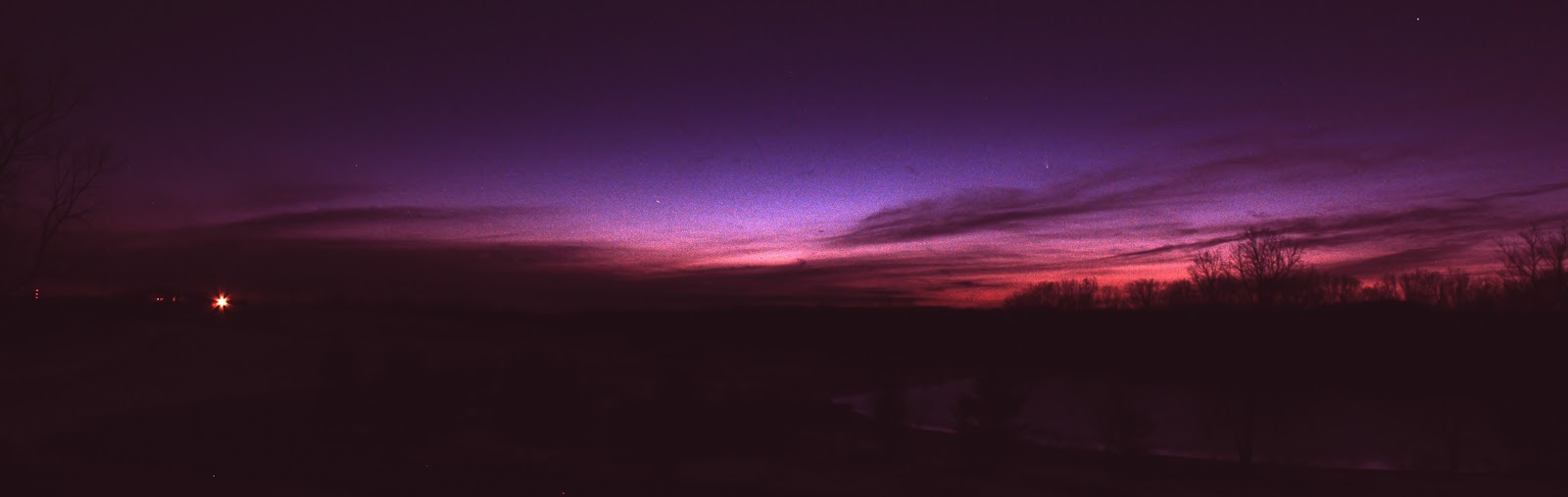
Here's a wide field looking photo from my wide field image (purple tinted) which I'm hoping to include and have in this months newsletter.
This was simple the wide field image cropped to look longer, more like a panoramic photo of the sunset.
The image was overly processed perhaps a bit, with a kind of experimental hit and miss setting using Nebulosity. I was trying to use Nebulosity (a program on the Macintosh) to get rid of hot spots that might be on the exposure, hot spots on the sensor or hot pixels can be removed with a "dark frame" processing or with "noise reduction" set to on for many digital cameras. I didn't have my noise reduction set to on when I took the photo, so I needed to get a dark frame. That dark frame, is supposed to be "at the same setting and temperature that the photo was taken at". I forgot to take dark frames when I took photos at Island Lake, so I was missing dark frames.
Dark frames are only good for the same camera, you can't use dark frames from one camera and process them with photos from a different camera. A dark frame is a frame of a dark image, like a photo taken with the lens cover on the camera, totally dark. Pixel dots on the image that are "hot" will show up in a dark frame. They are defective image sensors that glow hot due to defects that are in the camera sensor or develop as the sensor degrades over time. Some spots may permanently glow and look like they are white or red dots, usually they seem to be most noticed when they are red. They will always be on the same location. So a dark frame is a mapping of the bad parts of your camera sensor. You can take those dark frames and subtract the bad spots and fill those in with information from the area right next to the glowing pixels. This may be done automatically using programs that are designed primarily for astronomers, they do "dark frame" processing in the software and will remove the glowing hot pixels which may look like a red star, but are false stars or spots on the image.
Well that should be enough of an explanation. In Nebulosity I can remove dark frame noise. I tried to do this, but I'm not familiar with the Nebulosity interface, because I rarely use that program. I've used it in the past. So I took a RAW camera image and brought it into Nebulosity. I wanted to process the dark frame. I used dark frame subtraction from a dark frame that I took afterwards. I knew the frame would be fairly good, because I was able to look at the Metadata using a viewer called EXIF viewer off the internet. And I used this viewer to determine the temperature of the camera when Ken and I were out taking the photos of the comet. The camera was 2 degrees C. Or just above freezing. I tried to take dark frames by putting the camera outside this week but I couldn't get the camera chilled enough to get a dark frame photo that was cold enough. So I wrapped the camera in a clean, used bread bag and put the camera in my freezer in the kitchen. I set the camera to take time lapsed stills at the same frame rate and ISO setting inside my freezer. it was sitting inside with the ice cream and other stuff in my freezer. I reviewed the images, and found some 2 degree dark frames.
In Nebulosity I tried to apply a dark frame. I'm only working with one still "light frame" or exposure, so I only used one dark frame. I applied it, I really didn't check the results to carefully, maybe it worked, maybe it didn't totally work. I may review it later and try it again.
The RAW image looked really dark in nebulosity. So I tried to bring up the brightness using DDL features in Nebulosity. I like the power of Nebulosity, but the sliders and ways to vary the few settings inside it seem difficult to learn and at times are just a long frustrating trial and error. The image looked better, but still quite dark, and when I exported it, the image looked really dark. So I took the TIFF image exported from Nebulosity and opened it in Photoshop CS6. I tweaked the image some. I overexposed it a bit using curves and this caused some of the high levels of the image to be clipped. An over-exposure. It gave it a grainy glowing kind of look. I liked the look. It almost looked like a painting for a light box or something. With the light from the sunset being behind it.
I decided to use that and not try to look for a perfect rendition of the sky color. Nebulosity had colored the object and changed the tint to give it a purple cast or tint. I didn't mind that change, it was probably something I did with the DDL setting. I left that and exported that as a TIFF from photoshop. It almost looked a bit like a painting. I liked the detail of the clouds.
I tried to see if I could remove some of any noise it might have and clear up a bit of the grain. A bit of glowing grain, likely bright over saturated pixels existed in the image. I wanted to see if I could remove some of this grain using Neat Image Pro. I have the "stand alone version" because I bought it before I purchased Photoshop. So I played with Neat Image Pro, but the photo almost looked as good with the grain as with some of the changes I did with the noise reduction filter. The noise reduction filters didn't seem to do much, but when you zoomed in they gave it a painted fractal feel, almost like a surrealistic fractal pattern in some areas. It still looked good when at normal wide views, without a lot of zooming into details.
I could use either image. The Neat Image reduced version at normal wide views looks just as good. It might look really nice like some kind of art piece if it was blown up big and printed.
I cropped this a bit and had a closer version of the image. I played a bit with a label.
I also took one of the two images, and cropped it chopping off the top and bottom giving it a panoramic like feel. This might look good as some kind of long header or footer. This was what I eventually used as a footer on page one of my submission to Star Stuff. It probably won't print very well, but it will look great on a high resolution PDF for online viewing.
In any event, here is a copy of that cropped photo, after being processed with Nebulosity, Photoshop, Preview and possibly Neat Image. If you zoom in and see no fractal patterns it's the photoshop version before Neat Image "reduced" the noise. I can't remember which one I'm using in this post.

It's a lot of fun to play around with images you've taken. There's a lot to learn from imagers and astronomy imagers have a lot of information and spend a ton of time processing their photos.
I'm really just a moderately new beginner with astrophotography. Many in the group have better equipment skills and knowledge. There's a lot to learn out there.
I've been working on that today as it was cloudy out.
Here's a wide field looking photo from my wide field image (purple tinted) which I'm hoping to include and have in this months newsletter.
This was simple the wide field image cropped to look longer, more like a panoramic photo of the sunset.
The image was overly processed perhaps a bit, with a kind of experimental hit and miss setting using Nebulosity. I was trying to use Nebulosity (a program on the Macintosh) to get rid of hot spots that might be on the exposure, hot spots on the sensor or hot pixels can be removed with a "dark frame" processing or with "noise reduction" set to on for many digital cameras. I didn't have my noise reduction set to on when I took the photo, so I needed to get a dark frame. That dark frame, is supposed to be "at the same setting and temperature that the photo was taken at". I forgot to take dark frames when I took photos at Island Lake, so I was missing dark frames.
Dark frames are only good for the same camera, you can't use dark frames from one camera and process them with photos from a different camera. A dark frame is a frame of a dark image, like a photo taken with the lens cover on the camera, totally dark. Pixel dots on the image that are "hot" will show up in a dark frame. They are defective image sensors that glow hot due to defects that are in the camera sensor or develop as the sensor degrades over time. Some spots may permanently glow and look like they are white or red dots, usually they seem to be most noticed when they are red. They will always be on the same location. So a dark frame is a mapping of the bad parts of your camera sensor. You can take those dark frames and subtract the bad spots and fill those in with information from the area right next to the glowing pixels. This may be done automatically using programs that are designed primarily for astronomers, they do "dark frame" processing in the software and will remove the glowing hot pixels which may look like a red star, but are false stars or spots on the image.
Well that should be enough of an explanation. In Nebulosity I can remove dark frame noise. I tried to do this, but I'm not familiar with the Nebulosity interface, because I rarely use that program. I've used it in the past. So I took a RAW camera image and brought it into Nebulosity. I wanted to process the dark frame. I used dark frame subtraction from a dark frame that I took afterwards. I knew the frame would be fairly good, because I was able to look at the Metadata using a viewer called EXIF viewer off the internet. And I used this viewer to determine the temperature of the camera when Ken and I were out taking the photos of the comet. The camera was 2 degrees C. Or just above freezing. I tried to take dark frames by putting the camera outside this week but I couldn't get the camera chilled enough to get a dark frame photo that was cold enough. So I wrapped the camera in a clean, used bread bag and put the camera in my freezer in the kitchen. I set the camera to take time lapsed stills at the same frame rate and ISO setting inside my freezer. it was sitting inside with the ice cream and other stuff in my freezer. I reviewed the images, and found some 2 degree dark frames.
In Nebulosity I tried to apply a dark frame. I'm only working with one still "light frame" or exposure, so I only used one dark frame. I applied it, I really didn't check the results to carefully, maybe it worked, maybe it didn't totally work. I may review it later and try it again.
The RAW image looked really dark in nebulosity. So I tried to bring up the brightness using DDL features in Nebulosity. I like the power of Nebulosity, but the sliders and ways to vary the few settings inside it seem difficult to learn and at times are just a long frustrating trial and error. The image looked better, but still quite dark, and when I exported it, the image looked really dark. So I took the TIFF image exported from Nebulosity and opened it in Photoshop CS6. I tweaked the image some. I overexposed it a bit using curves and this caused some of the high levels of the image to be clipped. An over-exposure. It gave it a grainy glowing kind of look. I liked the look. It almost looked like a painting for a light box or something. With the light from the sunset being behind it.
I decided to use that and not try to look for a perfect rendition of the sky color. Nebulosity had colored the object and changed the tint to give it a purple cast or tint. I didn't mind that change, it was probably something I did with the DDL setting. I left that and exported that as a TIFF from photoshop. It almost looked a bit like a painting. I liked the detail of the clouds.
I tried to see if I could remove some of any noise it might have and clear up a bit of the grain. A bit of glowing grain, likely bright over saturated pixels existed in the image. I wanted to see if I could remove some of this grain using Neat Image Pro. I have the "stand alone version" because I bought it before I purchased Photoshop. So I played with Neat Image Pro, but the photo almost looked as good with the grain as with some of the changes I did with the noise reduction filter. The noise reduction filters didn't seem to do much, but when you zoomed in they gave it a painted fractal feel, almost like a surrealistic fractal pattern in some areas. It still looked good when at normal wide views, without a lot of zooming into details.
I could use either image. The Neat Image reduced version at normal wide views looks just as good. It might look really nice like some kind of art piece if it was blown up big and printed.
I cropped this a bit and had a closer version of the image. I played a bit with a label.
I also took one of the two images, and cropped it chopping off the top and bottom giving it a panoramic like feel. This might look good as some kind of long header or footer. This was what I eventually used as a footer on page one of my submission to Star Stuff. It probably won't print very well, but it will look great on a high resolution PDF for online viewing.
In any event, here is a copy of that cropped photo, after being processed with Nebulosity, Photoshop, Preview and possibly Neat Image. If you zoom in and see no fractal patterns it's the photoshop version before Neat Image "reduced" the noise. I can't remember which one I'm using in this post.
(click on the image below to see a larger version.) (c) Greg Knekleian
It's a lot of fun to play around with images you've taken. There's a lot to learn from imagers and astronomy imagers have a lot of information and spend a ton of time processing their photos.
I'm really just a moderately new beginner with astrophotography. Many in the group have better equipment skills and knowledge. There's a lot to learn out there.
Another Panstarrs Link
There are of course many links on the net regarding Comet Panstarrs.
Here is one that is interesting from Sky And Telescope, it has photos from different locations and dates and a diary from observers.
http://www.skyandtelescope.com/observing/highlights/185665152.html
Here is one that is interesting from Sky And Telescope, it has photos from different locations and dates and a diary from observers.
http://www.skyandtelescope.com/observing/highlights/185665152.html
Tonight there WAS a slight chance at seeing the comet, Friday may be better, but where do we go?
A big question now in my mind after visiting Island Lake last Sunday is where do I go to observe Comet Panstarrs today and more importantly Friday evening.
----
Update, looks like the weather conditions have changed and more clouds are predicted now. It looks like there will be no viewing of the comet from the Lincoln Park, Allen Park area the next two nights.
------
It may be clear enough in this area to view it. It may be clear enough at Island Lake to view it out near Brighton Michigan. Island Lake is located near Kensington Metropark. Quite a far ways away from us and also there are other sites out there that the FAAC club uses to view the comet. The comet might even be visible for a few minutes, maybe 5 to 10 minutes when it's up high from HJRO, but only with telescopes outside of the observatory.
I enjoyed the other views even though it was very cold from Island Lake, do to the darker skies. I feel like driving out to a darker sky site for Friday, but I'm not certain yet that I'll do that. I don't know if I'll stay around locally and watch the comet from Allen Park or try to view if from another location.
I'll try to post an update and send messages to some of you, if I'm going to be in Allen Park.
Others of course can look for the comet from up on the hill, but of course your better off observing it with binoculars, now it will likely not be visible to the naked eye without binoculars. Or use a "wide field" telescope, that gives very wide views. A typical low cost narrow field telescope that you might own, may not work very well if you can't find the comet to begin with. You really want something that can show the tail of the comet, so typical store bought long focal length telescopes may not do to well. Better to have something to look through than nothing. The telescopes we have been using for the most part have been wide field telescopes showing a couple degrees of view or more.

 Here's a different set of processed photos. These are much like the earlier ones from last Sunday, but these have a different look. These are not as accurate as the other photos were color wise. This photo has more of a purple tone, because the processing that I did changed the colors a bit. It's less accurate than earlier photos and technically is not showing the correct sky colors. It has a nice feel to it, but has over-saturation which gives it a warm glow from many dots that were over-brightened. It was also darker in some areas. It gives an interesting almost painting like look at the sunset, maybe a cheap painting with some kind of back light shining through it.
The levels were really low and the over-saturation comes from my wanting to adjust these and bring it up with more processing. The steps, in detail are not to important as these are basic shots of the comet and surroundings. The basic steps was some DDL processing using Nebulosity (for Macintosh), then bringing up some levels with RGB curves in Adobe photoshop, then changing the exposure center point and exposure slightly using Apple's preview utility, then noise reducing the image using Neat Image Pro stand alone. In the end we get this look that shows a photo which almost looks a little bit like a painting with emphasis on a darker purple shade. It also looks a bit like it's a photo that is backlit on a light box or something along those lines. I like it, but it's not exactly accurate as a photo.
Now the question might come to mind, can I see Panstarrs as good as in the photos above? You could not at that time see the comet as well as in this photo, because your eyes are smaller and gather less light than the camera did and you're not taking 4 second exposures like the camera did. And furthermore for low light color photography, your eyes are not going to pick up the true colors as the light gets dimmer, your eyes are only 5% efficient in converting color to a photo in your mind. The chip in modern cameras are 70% efficient in seeing color, so they can be setup to see much deeper colors of faint objects.
These shots show how Panstarrs would look through a nice pair of binoculars at a dark sky site.
Ken Anderson who was out with me said he briefly saw the comet naked eye as was surprise how bright it actually was. But he soon lost it even after claiming to see it once. So it's not an easy object to see without some optical aid. Now that the comet is moving away from the sun it will be even fainter and more difficult to pick up. Pretty soon you'll need a nice sized telescope to see it well and the midsized binoculars with lower power may not perform very well. We'll have to start bringing out bigger telescopes to see it.
----
Update, looks like the weather conditions have changed and more clouds are predicted now. It looks like there will be no viewing of the comet from the Lincoln Park, Allen Park area the next two nights.
------
It may be clear enough in this area to view it. It may be clear enough at Island Lake to view it out near Brighton Michigan. Island Lake is located near Kensington Metropark. Quite a far ways away from us and also there are other sites out there that the FAAC club uses to view the comet. The comet might even be visible for a few minutes, maybe 5 to 10 minutes when it's up high from HJRO, but only with telescopes outside of the observatory.
I enjoyed the other views even though it was very cold from Island Lake, do to the darker skies. I feel like driving out to a darker sky site for Friday, but I'm not certain yet that I'll do that. I don't know if I'll stay around locally and watch the comet from Allen Park or try to view if from another location.
I'll try to post an update and send messages to some of you, if I'm going to be in Allen Park.
Others of course can look for the comet from up on the hill, but of course your better off observing it with binoculars, now it will likely not be visible to the naked eye without binoculars. Or use a "wide field" telescope, that gives very wide views. A typical low cost narrow field telescope that you might own, may not work very well if you can't find the comet to begin with. You really want something that can show the tail of the comet, so typical store bought long focal length telescopes may not do to well. Better to have something to look through than nothing. The telescopes we have been using for the most part have been wide field telescopes showing a couple degrees of view or more.

(A wide field shot processed with more of a purple oversaturated sky glow feel.)
(c) Greg Knekleian Panstarrs over Spring Mill Pond at Island Lake State Park, Brighton Michigan.
Cropped a bit below, with that same purple over-saturated feel.

The levels were really low and the over-saturation comes from my wanting to adjust these and bring it up with more processing. The steps, in detail are not to important as these are basic shots of the comet and surroundings. The basic steps was some DDL processing using Nebulosity (for Macintosh), then bringing up some levels with RGB curves in Adobe photoshop, then changing the exposure center point and exposure slightly using Apple's preview utility, then noise reducing the image using Neat Image Pro stand alone. In the end we get this look that shows a photo which almost looks a little bit like a painting with emphasis on a darker purple shade. It also looks a bit like it's a photo that is backlit on a light box or something along those lines. I like it, but it's not exactly accurate as a photo.
Now the question might come to mind, can I see Panstarrs as good as in the photos above? You could not at that time see the comet as well as in this photo, because your eyes are smaller and gather less light than the camera did and you're not taking 4 second exposures like the camera did. And furthermore for low light color photography, your eyes are not going to pick up the true colors as the light gets dimmer, your eyes are only 5% efficient in converting color to a photo in your mind. The chip in modern cameras are 70% efficient in seeing color, so they can be setup to see much deeper colors of faint objects.
These shots show how Panstarrs would look through a nice pair of binoculars at a dark sky site.
Ken Anderson who was out with me said he briefly saw the comet naked eye as was surprise how bright it actually was. But he soon lost it even after claiming to see it once. So it's not an easy object to see without some optical aid. Now that the comet is moving away from the sun it will be even fainter and more difficult to pick up. Pretty soon you'll need a nice sized telescope to see it well and the midsized binoculars with lower power may not perform very well. We'll have to start bringing out bigger telescopes to see it.
Tuesday, March 19, 2013
Panstarrs 10 frame animation, played slowly on Youtube, from last Sunday
Here's a link to a quick draft animation of Comet Panstarrs technically of course it's Panstarrs 2011 L4.
This video is just ten frames. I didn't take a camera controller setup to take longer photo sequences and for a while was taking 4 shot sequences not realizing I didn't reprogram the CANON EOS to take 10 shots instead.
These shots are 4 seconds each, so if we advanced the playback of each frame at 4 seconds per frame we can see how fast the comet is moving in real time. The comet looks like it's barely moving of course when it's zoomed out to the wider framing of the image capture.
http://www.youtube.com/watch?v=2EPLWTHAz7U&feature=youtu.be
I did a zoom in but this zoom was zooming in on a wide frame capture of the slidehow, so it's not as high a resolution had I cropped the original images and zoomed them in and played it back at different cropped resolutions. The zoom suffers from having a base resolution of the screen resolution of playback.
I may create a better resolution movie later. Also I probably didn't chose the right keyframe rate for the rendering in Screen flow so at times the image is blurry as the "keyframe" should be a new frame from a new scene. They don't line up so the compression for the movie sometimes messes up the image and you'll see pixelation.
This gives you a rough idea how the comet moved.
It's not as bright and is visible to a person using binoculars, but difficult for some to see naked eye. Especially in brighter skies or when the sky is not dark enough.
This kind of comet is kind of difficult to find sometimes. It's a target that can be found easier if you have a few friends or even a half a dozen people looking for it wtih binoculars and wide field telescopes. That gives you a chance to have someone find it.
Better of course if you have a tripod as well to fix the telescope or binocular that finds it so you can figure out where it is. Ken found it first, but was using a binocular on a monopod and it seemed so bright to him that he could see it naked eye when he took the binocular away. When he moved however he lost it. Make sure you locate some kind of land mark and not move to far or get to excited when you first spot it until other friends can see it and get good frame of reference to see the comet.
Sunday, March 17, 2013
A few photos from tonight's viewing of the comet

Ken Anderson and Greg Knekleian viewing the comet, while Orion the moon, Jupter and M45 shine brightly overhead. There is no comet inside the photo framed above, the blur in the top right corner is simply flaring from the moon on the camera lens.
(Yes, I know the moon is overexposed, I didn't think to take multiple exposures of this to bracket and layer this, making it more realistic.)
How I ended up in Milford instead of locally to view the comet.
I was planning on trying to view the comet from Allen Park, but as I was driving I noticed a lot of clouds. I called a few members of the FAAC club and found out some were going to be looking at the comet out a ways. They claimed that the clouds looked pretty bad, but there was some thinning of clouds.
I had planned to meet James and perhaps a few others. James told me he wanted to meet in Allen Park if the sky looked promising.
While driving and looking at the clouds and layers and layers of clouds and haze, on multiple levels, I decided that I should head out to try to find a better viewing area.
I drove out toward Dexter last week to see if conditions would improve, but they didn't. This time I'd head out toward Milford.
I drove out I-94 toward I275. Clouds in the west looked thick with some breaks but they didn't look good toward Ann Arbor. I called a friend and asked him if it was cloudy in Dexter. He said yes. A bad sign. Ann Arbor weather travels toward the downriver much of the time.
As I was turning onto I275 I called James to let him know I made a last minute decision to ditch the viewing in Allen Park due to clouds. I mentioned I didn't think the clouds would clear up around here and I was risking the same thing but driving out quite a ways, in hopes of seeing the comet or at least to chat with members way out that way, if the clouds were bad out there.
Things didn't look very good, but the cloud bands seemed to thin out a bit toward Plymouth. As I turned onto I96 toward Milford the sky looked pretty good but some thick cloud bands were in the distance toward the setting sun. This might be bad, I thought, because I'm driving toward the cloud bands. Shouldn't I be driving in the opposite direction as the sky was fairly clear above me?
It's tough to race the clouds and setting sun.
I stopped to get some gas in the car in Novi Michigan. It was cold out, and I decided to grab a few hot chocolates as George and Ken said they'd try to be there and observe. With 3 large hot chocolates from Tim Horton's I continued my trip. The sun was setting and I was running a bit late.
We were going to observe at a FAAC observing site, where we have permission to be after dark. At least one of the sites. One of the reasons people join astronomy clubs is clubs get permission to use certain sites and watch the stars late at night, without being thrown out of a park.
So I finally arrived at Island Lake State Park, and drove in to meet Ken and George.
Ken was there up on a hill near Spring Mill pond. He was up there alone, George should have been there ahead of me. The walk up the hill in partly snowy conditions caused me to change my equipment deployment plans a bit. Ken and I used binoculars. I took up my binocular telescope, my Canon EOS camera and a couple tripods. Ken had two binoculars up there, actually more than two, but two were setup on tripods or monopods.
Ken was looking for the comet and thought he saw it and he described where he thought he saw it. Above 5 degrees above the horizon. This was around 8PM when he looked and thought he saw the comet. It was way higher than 5 degrees, but we were unsure of where the true horizon was. I mentioned it was likely 13 degrees above at 8pm and probably about 10 degrees above at 8:20.
The sky continued to get darker, and we scanned the skies, but didn't see it at first.
I setup the Canon EOS and took some wide angle photos. The wind was blowing and fairly cold up on the hill. I forgot my gloves in the car. Then Ken saw the comet through his medium size binoculars. I think he said they were 15 by 70mm or something in that size range. He also had 25 by 100 binoculars which were nice.
Ken saw the comet through his binocular on a monopod, but he was near my camera when this happened. As he moved to the location of the bigger binocular, he somehow lost the bearing on the comet's location. He said I can see it naked eye as well, when he first saw it. But then he couldn't find it.
This is an object that can easily use more than one set of eyes and pairs of binoculars to look for it. It's better to be in a group. I scanned around, looked it up on the Sky Safari app and tried to locate it. Then I found it in the BT-80 binoculars and we were able to get a fix on the location for more viewing.
There were some clouds and haze, they looked thin and cut down on the clarity of the comet some. But we could still see the comet.
I took some photos at 1600 ISO then reframed them and took some closer ones with the Canon EOS camera. I thought about getting the Nexstar 4SE and hauling it up, but I didn't have it mounted on the Vixen telescope as I wanted to use it piggyback on the Vixen binoculars to take close up photos.
We were enjoying viewing the comet to much for me to make another trip and project. The change in location, changed the equipment we could deploy easily.
We ended up taking some nice photos of the comet and enjoying the view. We took a few photos of use looking up as well and one facing the camera with the comet in the background. This background comet photo was taken later in the evening as it faded more and more and was quite low, so that photo op was planned a little to late, to get a better shot of the comet in our background.
Once home I decided to do some quick editing of some of the photos. Really basic editing, making a few adjustments in Preview on the Mac, which is really basic and also using Neat Image Pro noise reduction to get rid of any noisy grain that might overwhelm the photo.
Below are some of the results. These images were edited fairly quickly.
I like editing the images and playing with different edit tools in different programs.
This photo is cropped a bit from a wider shot. I processed this photo to give it a darker look that kind of matched what we saw. The camera picked up more detail and makes the image much brighter with a fixed 4 second exposure at 1600 ISO.
By cropping and saving the photo we have a photo that is framed closer and shows the comet more.

Do you want to see the wider shot. I know the above photo looks wide, but I was using a wide lens setting, not zoomed in at all really. So the actual shot doesn't even show the comet clearly, but you can see how wide the area was and the nice wide angle vista of our western horizon.
(Note I didn't put a graphic on this photo, but all photos on this page are copyrighted by me. I don't have a problem with people using them to promote astronomy or for club use. )
(If you have a question about these photos or want to use them just drop me a note at GKnekleian@gmail.com)

I also took a few photos of us up there. Nice to get some documentation of the viewing experience.
This photo was also a long exposure 15 second exposure and the comet is blurred a bit. If I look blurry as well, it's because I moved more during the long exposure. I brightened up the photo a bit to show you a little bit of us in the photo. The photo looks much brighter than the actual area was. It's like turning night into day. I actually couldn't even see Ken very easily to setup the photo framing. The Canon EOS has a bright back that blinded me before I looked in the viewfinder to frame the shot below.

(Above, 15 second exposure. I"m standing near the Vixen BT-80 and Ken is standing to my right. The comet is above my left shoulder. The comet was lower and dim in the clouds when we took this photo. You probably can't see it in the photo above. You will have to click on the photo to see the enlarged version of it.)
After the comet set, we started looking at some other objects. These included: the Moon and Jupiter close together, M45 nearby and of course the Orion Nebula. Ken then gave me a quick tour of a few objects before the clouds moved in. With fast arriving clouds, covering the sky, we were lucky to get any viewing in at all. Ken I'm sure has better observing notes and he was showing me many interesting things in the sky as clouds entered over the sky causing us to end the night earlier than we might have. We were driven from the field by the clouds.
Also:
M42 looked so amazing out there in dark skies compared to the bright skies of Allen Park and Lincoln Park. I really enjoy being in a darker sky for observing.
Subscribe to:
Posts (Atom)